
Skin assessment
Consultation and scalp or skin assessment with hair loss diagnosis confirmation.
Platelet-Rich Plasma injections for androgenetic alopecia, telogen effluvium, under-eye rejuvenation, and facial skin quality improvement.
PRP (Platelet-Rich Plasma) therapy uses the patient's own blood to concentrate platelets and growth factors that are then injected into the scalp for hair loss or the face for rejuvenation. At Skin Clinic by Dr. Eram Razzaq, PRP is used for androgenetic alopecia (male and female pattern hair loss), telogen effluvium, under-eye hollowing, and overall facial skin quality — with a course of 3 to 6 sessions spaced 4 weeks apart.
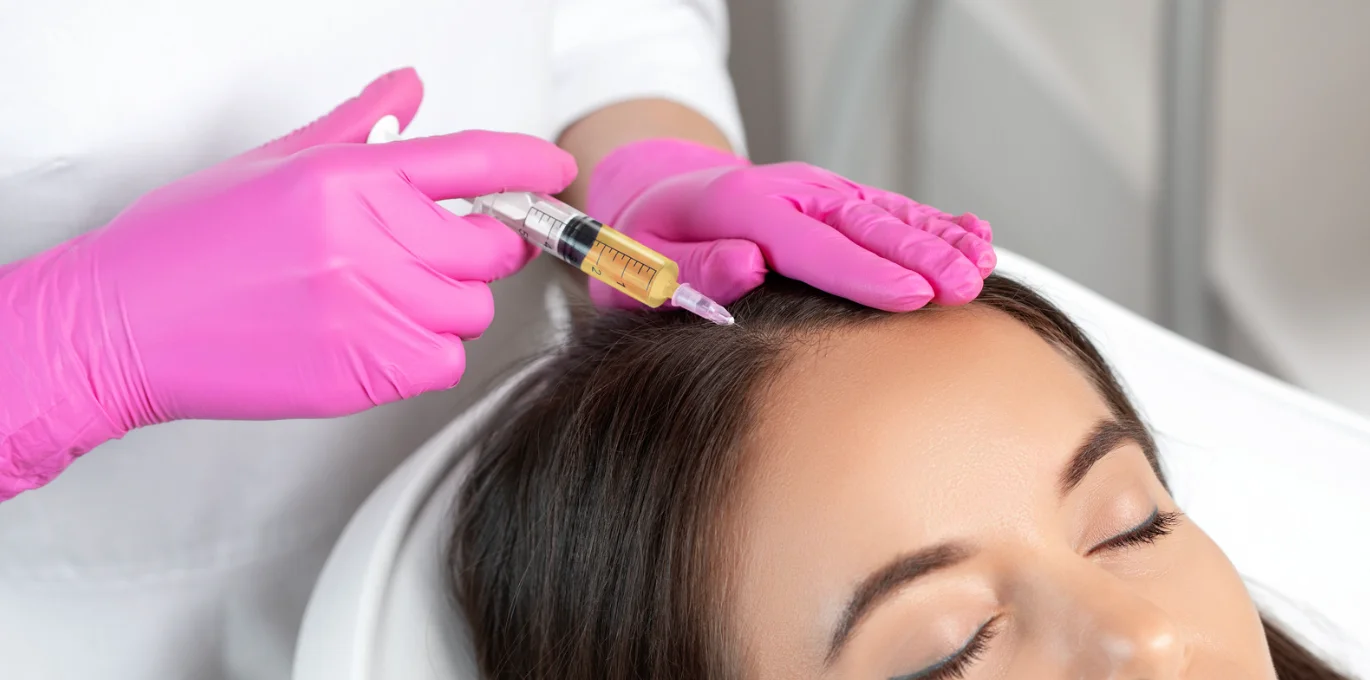
PRP is prepared by drawing a small amount of blood, centrifuging it to separate the platelet-rich plasma, and activating the platelets to release growth factors including PDGF, VEGF, and TGF-β1 (Transforming Growth Factor Beta 1). When injected into the scalp, these growth factors stimulate hair follicles in the dormant (telogen) phase to re-enter the active growth (anagen) phase and improve follicle thickness and health. Facial PRP injections improve skin quality, hydration, and collagen production. At Skin Clinic by Dr. Eram Razzaq, PRP is also frequently combined with microneedling or CO2 laser to amplify treatment outcomes.
Suitability is confirmed after skin examination, medical history, lifestyle review, and realistic expectation setting.
Consultation and scalp or skin assessment with hair loss diagnosis confirmation.
Blood draw (15 to 20ml) and centrifugation to prepare PRP.
PRP injection into the scalp or facial skin using fine needles.
Post-treatment scalp care instructions and next session scheduling.
A clear appointment pathway helps you understand assessment, procedure planning, recovery guidance, and follow-up before booking.
Consultation and scalp or skin assessment with hair loss diagnosis confirmation.
Blood draw (15 to 20ml) and centrifugation to prepare PRP.
PRP injection into the scalp or facial skin using fine needles.
Post-treatment scalp care instructions and next session scheduling.
Patient feedback focused on consultation quality, comfort, aftercare guidance, and realistic treatment planning.

“The consultation was clear and calm. I understood what the procedure could do, what it could not do, and how to care for my skin afterward.”
“Dr. Eram checked my skin properly before suggesting treatment. The explanation felt honest and practical.”
“Clean clinic, respectful staff, and simple aftercare instructions.”
“I liked that the treatment plan was not rushed. They explained session spacing, expected recovery, and follow-up clearly.”
“My skin concern was discussed in detail. The team made the complete journey easy to understand, from assessment to aftercare and review.”
These answers are general guidance. Your actual plan depends on examination, skin type, medical history, and treatment suitability.
PRP is used for androgenetic alopecia, telogen effluvium, facial rejuvenation, under-eye skin quality, and as an add-on to laser or microneedling.
Blood is drawn from the patient, centrifuged to separate platelet-rich plasma, and activated before injection — making it autologous and biocompatible.
A course of 3 to 6 sessions spaced 4 weeks apart is typically recommended, followed by maintenance every 3 to 6 months.
Hair response is gradual — reduced shedding may be noticed at 4 to 8 weeks, with visible density improvement at 3 to 4 months.
Yes. PRP is effective for female androgenetic alopecia and telogen effluvium after diagnosis confirms these as the cause.
Yes. PRP is autologous (from the patient's own blood) and has a strong safety profile when prepared and injected with proper sterile technique.
Scalp injections cause mild prickling. Topical numbing is available for patients with lower pain tolerance.
Yes. PRP applied after microneedling significantly enhances the collagen induction and follicle stimulation effects.
No. PRP works for androgenetic alopecia and telogen effluvium. Scarring alopecias require different treatment and must be diagnosed first.
Yes. Hair loss type must be diagnosed correctly before PRP is started, as the wrong diagnosis leads to ineffective treatment.
Share your concern and the clinic team will guide you about appointment availability, suitability review, and the next step with Dr. Eram Razzaq.