
Have you noticed a dark, velvety band around your neck that refuses to fade no matter how hard you scrub? Perhaps a family member has hinted that it is a hygiene problem, or you have already tried lemon juice, whitening soaps, and scrubs with nothing to show for it. If this sounds familiar, you may be looking at acanthosis nigricans, a skin condition that deserves a medical answer, not another loofah.
Acanthosis nigricans is one of the most common reasons patients ask us about dark neck treatment. The condition is not dirt. In many people, it is the skin’s way of signalling something deeper, most often insulin resistance.
In this guide you will learn what acanthosis nigricans looks like, why it happens, how a dermatologist investigates it, and what realistic, safe treatment actually involves.
What Acanthosis Nigricans Looks Like
Acanthosis nigricans causes dark, thickened, velvety patches of skin. The back and sides of the neck are the most common site, but patches also appear in the underarms, the groin, under the breasts, and over the knuckles and elbows.
The texture is the giveaway. The area feels soft and slightly raised, more like velvet than a flat tan. In South Asian skin, which is naturally rich in melanin (the pigment that gives skin its colour), the patches often look deep brown or nearly black.
Some patients also develop small skin tags in the same areas. These are harmless, but they tend to travel with the same underlying causes, so they are a useful clue during examination.
Why Scrubbing a Dark Neck Backfires
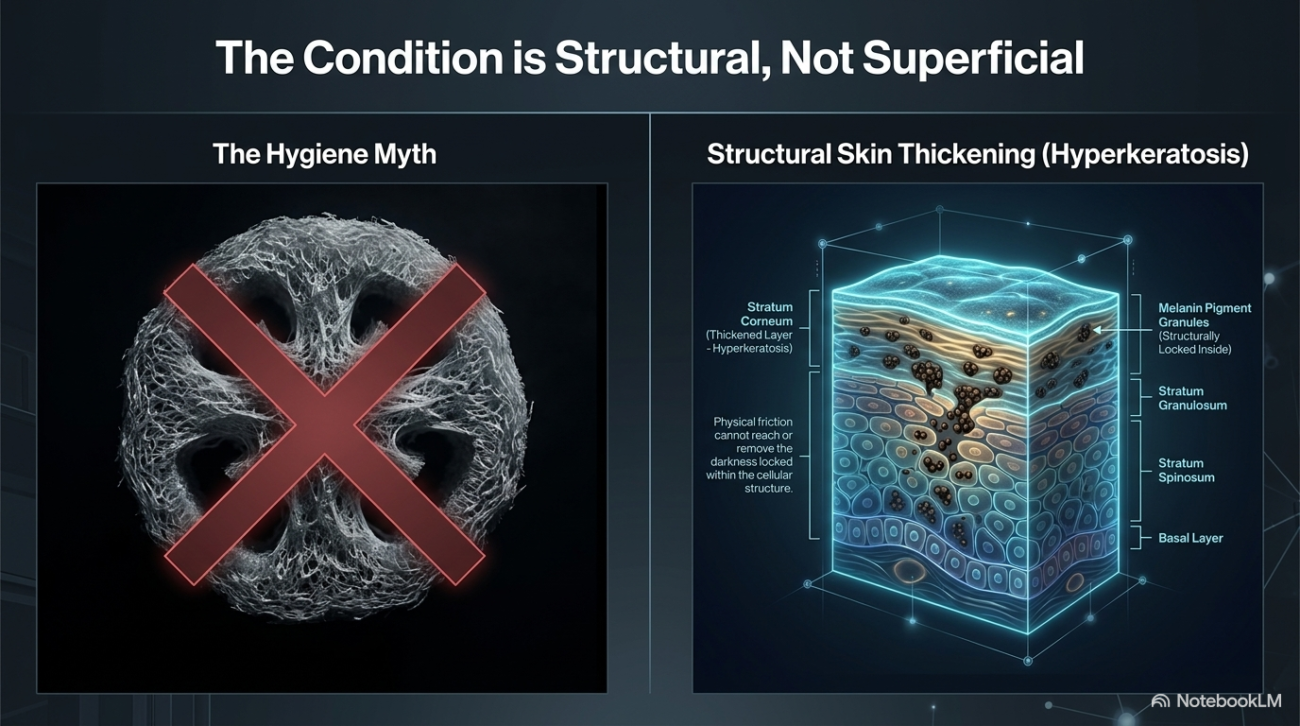
Many patients arrive after months of scrubbing with loofahs, whitening soaps and home remedies. It is an understandable instinct, but it is the wrong one. The darkness sits inside a thickened layer of skin, not on top of it, so no amount of rubbing can wash it away.
Worse, aggressive friction inflames the area. Pakistani skin generally falls into Fitzpatrick types III to V, which are prone to post-inflammatory hyperpigmentation, or PIH – extra pigment the skin produces after any irritation. In plain terms, scrubbing a dark neck usually makes it darker. Unregulated bleaching creams can do the same, and some contain harmful ingredients such as strong steroids or mercury, so please avoid them entirely.
The Real Causes: Insulin Resistance, PCOS and Medicines
The most common driver of acanthosis nigricans is insulin resistance. Insulin is the hormone that moves sugar from your blood into your cells. When the body stops responding to it properly, insulin levels rise, and high insulin pushes skin cells and pigment cells to overgrow. The result is a thick, dark, velvety patch.
That is why these patches are so often seen alongside:
- Prediabetes, type 2 diabetes, or a strong family history of diabetes
- Polycystic ovary syndrome (PCOS), a hormonal condition in women that often brings irregular periods and acne
- Weight gain, especially around the waist
- Certain medicines, including long-term steroids and some hormonal treatments
Rarely, acanthosis nigricans that appears suddenly and spreads widely, especially in an older adult, can point to an internal illness. That is one more reason a proper medical review matters more than any cream.

What Dark Neck Treatment Involves at a Dermatology Clinic
Effective dark neck treatment starts with a diagnosis, not a product. Your dermatologist will examine the pattern of the patches and ask about weight changes, periods, medicines and family history. The diagnosis is usually clinical, meaning it can be confirmed by examination alone.
Next comes the workup. Depending on your history, this may include fasting blood sugar, HbA1c (a three-month average of blood sugar), fasting insulin, a lipid profile, and hormonal tests if PCOS is suspected. This step separates medical care from parlour treatments: we look for the cause, not just the colour.
Treating the root cause does the heavy lifting. When insulin resistance improves through weight management, a lower-sugar diet, regular activity and any medicines your physician prescribes, the patches often soften and fade gradually on their own.

Adjuncts that help the skin itself
Alongside root-cause care, dermatologist-led treatments can speed up visible improvement. Topical retinoids, vitamin A creams that increase skin cell turnover, help thin the patch over several weeks. Gentle chemical peels performed at the right strength and interval can lift thickened, pigmented layers safely in darker skin. In selected resistant cases, pigment-targeting options such as pico laser therapy may be considered, always with settings chosen for type III to V skin.
What we avoid matters just as much: no harsh bleaching, no deep peels on irritated skin, and no scrubbing.
Realistic Expectations and Timeline
Acanthosis nigricans responds slowly, and honesty about that protects you from wasted money. Skin that thickened over years will not clear in two weeks. Most patients who address the underlying cause and follow a supervised plan begin to notice softening and gradual lightening over roughly three to six months.
The neck may never become perfectly even in tone, and that is normal. The realistic goals are a visibly lighter, smoother, healthier area – and better metabolic health, which matters far beyond the mirror. Maintenance counts too: if weight or insulin resistance creeps back up, the patches can return with it.
Frequently Asked Questions
Is a dark neck always a sign of diabetes?
No. Acanthosis nigricans signals a higher likelihood of insulin resistance, but not everyone who has it is diabetic. Some cases relate to PCOS, medicines or family tendency. Simple blood tests give the real answer, which is why testing is part of any good dark neck treatment plan.
Can whitening creams from the market cure it?
Over-the-counter whitening creams rarely help, because they address neither the thickened skin nor the underlying cause. Some unregulated creams contain strong steroids or mercury, which can permanently thin and damage skin. Please use only what a qualified doctor prescribes for you.
Will the dark patches come back after treatment?
They can, if the underlying driver returns. Patients who maintain a healthy weight and keep blood sugar under control typically hold their results well. Occasional maintenance, such as a mild peel or a retinoid cream, helps keep the area smooth and even.

When to See a Dermatologist
Book a medical review if you notice new velvety dark patches on the neck, underarms or knuckles, if an existing patch is spreading quickly, or if you have risk factors such as a family history of diabetes or PCOS. Children and teenagers with these patches should be assessed too, because early insulin resistance is increasingly common.
If a dark neck has been troubling you, Dr. Eram Razzaq at Skin Clinic, Bahria Town, Lahore offers a complete assessment: the right blood tests, honest advice and a safe, skin-type-appropriate dark neck treatment plan. Call 0304-1115000 or book a consultation to take the first step.
This article is for general information only and is not a substitute for a professional medical diagnosis. If you have a persistent skin or hair concern, please consult a qualified dermatologist.